FOR WANT OF A BETTER
STRANGER IN A FAMILIAR LANDSCAPE
Alban Van Wassenhove
06 April 2027 – Théâtre de l'Arsenal - Scène conventionnée d’intérêt national – Dance, Val-de-Reuil.
20 May 2026 – Festival Danser Partout – Chorège, CDCN de Falaise, at the National Choreographic Centre, Caen
22 May 2026 – L’Étincelle, Théâtre(s) de la Ville de Rouen
STRANGER IN A FAMILIAR LANDSCAPE
Direction and voice : Deborah Lennie
Dance : Annie Hanauer, Ingvild Marstein Olsen
Sound creation : Patrice Grente
Film : Christophe Bisson
Lighting : Jérôme Houlès
Costumes : Magali Murbach
What are the first sounds you hear when you wake up?
Can you see the sky from your room?
Do you walk by a glacier on your way home?
The places of our lives leave traces on our bodies, our ears, our eyes, our skin... and on the way we inhabit the world.
So what happens when we leave? And when we return, how is it that what was once so familiar, suddenly feels so strange?
Through dance, music, and film, STRANGER IN A FAMILIAR LANDSCAPE explores the intimate link between memory and place.
Between Australia, the United States, and Norway, three performers weave a story of wandering and belonging — one that might just well be all of ours.


PROJECT HISTORY
STRANGER IN A FAMILIAR LANDSCAPE was born from the collaboration between Deborah Lennie, Annie Hanauer, and Ingvild Marstein Olsen during their work on PUSH, the company's previous creation. By exchanging stories about their respective countries, they realized that they had very different relationships to fundamental physical elements of daily life: sensitivity to light, to cold, the way they perceived open or closed spaces…
All three have experienced exile, forced to work and live, sometimes for long periods, far from their country of origin, where these differences are particularly felt. Convinced that our relationship to the world is not solely determined by our personal or family history, a question then arose: how does the place where we live affect our relationship to our own body and to others?

i fall, will i hurt myself?
Og hvis jeg faller, vil jeg slå meg?
RESEARCH NOTES
The physical and acoustic aspects of the landscape are the broadest fields of our exploration. During our stays in our respective countries, we sought to inscribe in ourselves the characteristics of these landscapes through elements such as the brightness of light, the crushing heat that slows everything down, the sand slipping from under our feet, the terrifying cracking of ice, the smell of burning eucalyptus, the starry vault, the polar night, the deep forests, the skyscrapers—modernity, concrete, glass, disjointedness.
We considered the climate: are temperatures extreme or mild? Is the weather very changeable, or fairly stable? Is the soundscape hushed, as in Norway, or raucous, as in Australia? Are there untouched natural spaces where we grew up, and are they a source of physical danger: precipices, raging seas, a killer sun, deadly cold... or, on the contrary, a place to rest and recharge our batteries by a lake, or in tranquil grasslands? And how does the body come into contact with physical materials: rocks, concrete, sand, pastures? When playing as a child, did we fall on bitumen or on soft grass? How does the sun rise in the morning?
At Wahroonga in Australia, for example, the morning awakening is frighteningly brutal: the wildlife wakes up at the same time, like an explosion. There are no gentle twilights either: in ten minutes, night follows day.
All these factors contribute to a physical universe that places different demands on our bodies. So, when we are confronted with other types of landscape, other relationships with the sky, sun, weather and materials, how do we react? How can we accept or reject these differences?

Pieter Brueghel l'ancien, Paysage avec la Fuite en Égypte, 1563
We also considered the representations we grew up with. What is our collective imagery? What are the visual and sonic representations we grew up with? Our perception of landscape is not only formed through lived experience, but also through the images that surround us. Paintings, photographs, films, and visual and sonic archives have shaped ways of seeing and hearing, and with them, our relationship to the body, to space and to the horizon. Throughout the research, we looked at how these representations continue to inform our perception, often without us being aware of it.
THE BODY RE-SOUNDS LIKE A STORY
"Our perception of space depends as much on what we hear as on what we see."
Max NEUHAUS
The creation of a soundscape is central to the creation of this performance and an integral part of its dramaturgy. Patrice Grente has composed the soundtrack in direct relation to the work on stage, after a period of gathering and recording with Annie, Deborah and Ingvild.
In La Haine de la Musique, Pascal Quignard writes: "Ears have no eyelids". Indeed, we cannot choose what enters us through our earholes and what does not. And this is true long before birth. Waves penetrate right into the womb, bathing us in a very specific and individual universe of sound that affects us physically:
"In utero, it is around 30 weeks that the first motor responses to noise are stably recorded: from eyelid blinking to more or less generalized startle, depending on the intensity and frequency composition of the stimulus; and cardiac: acceleration." (Birnholz, Benaceraff, 1983; Kisilevsky, 1995). Carolyn Granier-DEFERRE, Marie-Claire BUSNEL,
L'audition prénatale, quoi de neuf ? Spirale 2011/3 (n°59) p. 17 to 32
Sound is a landscape in itself: the Australian bush is nothing like Norwegian glaciers or Minnesota lakes. The anguish that fills your stomach at the sound of approaching bush- fires. Or of ice cracking on the glacier. Emotional ties to sound are inevitable. And yet, over the course of our lives, we learn to unconsciously filter the sounds that reach us. Our ears pick out familiar and foreign sounds, and process them in different ways; we learn to develop symbolic eyelids. What are the sounds we have grown up with ? And what are these sounds that we block out?

"The physical aspect of a soundscape consists not only in the sounds themselves, the waves of acoustic energy that permeate the atmosphere in which people live, but also in the material objects that create, and sometimes destroy, these sounds. The cultural aspect of a soundscape incorporates scientific and aesthetic ways of listening, the listener's relationship with his or her environment, and the social conditions that decide who gets to hear what".
Emily Thompson , The Soundscape of Modernity: Architectural Acoustics and the Culture of Listening in America, 1900-1933, Cambridge, M IT Press, 2004, p. 1-2.
Our relationship with sound carries something of our history. And when sound becomes language, this history continues to be written. We explore the physical side of language : the voice. Each language resonates in different parts of the body: some languages resonate more in the nose, others in the pelvis, for example. In Stranger in a Familiar Landscape, all three of us have a different relationship to language, oscillating between French, English and Norwegian. Do the specific sounds of our languages affect our bodies and emotions?
Patrice Grente has used field-recording, archives, improvisation and composition. The three performers carry their different soundscapes within them, and the sound sources for the piece are drawn from these differences. From the sounds of the Australian bush, Norwegian glaciers, american pop to classical masterpieces embedded in our collected conscious, through low-tech recordings, live-voice and languages, urban ambiences, a soundscape is constructed. Like the background noise of life coming to the fore.
IMAGE
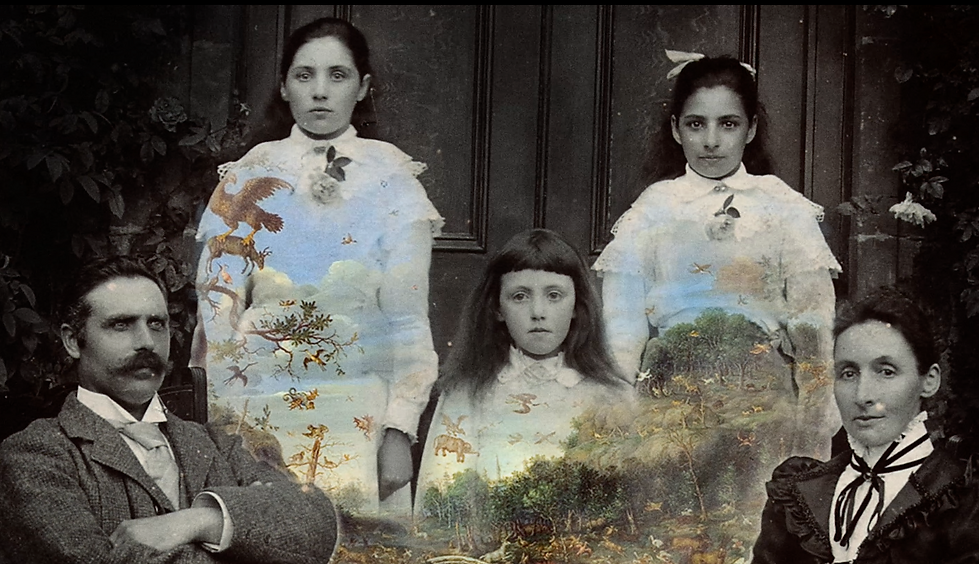
The work on image in Christophe Bisson’s films lies somewhere between archive-documentary and the history of painting: on the verge of reality. In STRANGER IN A FAMILIAR LANDSCAPE, his images do not illustrate anything, nor do they serve as moving decoration. There are no films of Australian sunsets or Norwegian glaciers, nor of American suburbia or sublime Minnesotan lakes. They are films which reflect something of the situation of exil, of the violence of leaving, of confronting ourselves with our memory. They are films in their own right, and at the same time deeply connected to the bodies, space, light, and sound of the piece.
During our creative process, particularly throughout our residency periods, we filmed movements, dance, gestures, journeys, landscapes to find resonances with existing imagery and our questions. Christophe has conducted much archival research. The question of our relationship to history is central to this project and resonates through the cinematic approach. Archival footage and pieces of our memory are the subjects of filmic experimentation and leave the audience wondering what is their personal relation to image, memory and exile.